Software Testing Fundamentals
Software testing is a fundamental practice in software engineering that involves systematically evaluating a piece of software to find defects and verify that it meets its specified requirements. The ultimate goal is to ensure the delivery of a high-quality, reliable, and performant product. Testing can be a manual or automated process and is performed at different levels throughout the development lifecycle.
This section introduces the core concepts of software testing, organized around the well-known Testing Pyramid.
The Testing Pyramid
The Testing Pyramid is a model, popularized by Mike Cohn, that provides a framework for thinking about a test automation strategy. It advocates for having a large number of fast, low-level unit tests at the base, fewer integration tests in the middle, and a very small number of slow, end-to-end tests at the top.
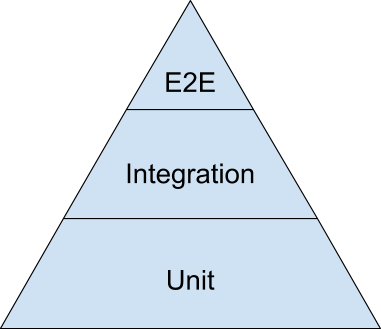
Description: The Testing Pyramid, showing Unit Tests as the wide base, followed by a smaller layer of Integration Tests, and a narrow peak of End-to-End Tests. This illustrates the recommended ratio of test types.
Levels of the Pyramid
- Unit Tests: These form the foundation of the pyramid. They test individual components or functions in isolation, are fast to execute, and provide precise feedback to developers.
- Integration Tests: This layer verifies that different components or services work together as expected. They test the communication and data flow between modules, such as interactions with a database or a third-party API.
- End-to-End (E2E) Tests: At the top of the pyramid, these tests validate a complete user workflow from start to finish. They simulate real user scenarios in a production-like environment but are slow, brittle, and expensive to maintain.
A fourth category, Functional Testing, is a broader classification that can encompass all these levels, as it focuses on verifying the software against its functional requirements.
Related Methodologies and Practices
The principles of testing are central to several modern development methodologies:
- Test-Driven Development (TDD): A practice where developers write unit tests before writing the production code required to make them pass.
- Behavior-Driven Development (BDD): An extension of TDD that focuses on defining the system’s behavior from the user’s perspective, often using a natural language format that can be understood by non-technical stakeholders.
- API Testing: A specific form of integration testing that focuses on validating the correctness, performance, and security of Application Programming Interfaces.
- Test Doubles: Stand-in components like Mocks, Stubs, and Fakes that are used to isolate the code under test from its dependencies.
Resources & links
Articles
-
Software Testing Introduction & Importance - Guru99 This article provides a comprehensive introduction to software testing, defining its purpose and importance in the software development lifecycle. It covers the benefits of testing, such as cost-effectiveness and security, and explains the different levels and types of tests.
-
The Practical Test Pyramid - BrowserStack This guide from BrowserStack explains the Testing Pyramid as a strategic framework for test automation. It details the roles of unit, integration, and end-to-end tests, emphasizing the trade-offs between speed, cost, and reliability at each level.
Videos
- The Testing Pyramid Explained (Video) This video provides a visual explanation of the Testing Pyramid, detailing its layers and the rationale behind the recommended distribution of different test types. It’s a great resource for understanding the strategic approach to test automation.